
TokenPost.ai
Roughly $326.71 million in leveraged crypto positions were liquidated over the past 24 hours, with losses skewing heavily toward bullish bets—an indication that a sudden downside move caught a crowded long market off guard.
Data compiled from CoinGlass shows long liquidations totaled about $285.87 million, accounting for 87.5% of the wipeout, while short liquidations reached roughly $40.84 million, or 12.5%. In derivatives markets, a liquidation occurs when a trader can no longer meet margin requirements and an exchange force-closes the position, often accelerating price moves as forced selling ripples through order books.
In the most recent four-hour window, Binance led exchange-level liquidations with about $4.72 million. Notably, 62.15% of those liquidations were shorts, suggesting some traders were positioned for further downside but were squeezed during short-lived rebounds. Bybit followed with approximately $909,840 liquidated, where longs represented 52.17% of the total. OKX recorded about $733,450 in liquidations, with shorts making up 58.78%.
Among smaller venues, Aster stood out for the composition of losses: shorts accounted for 68.8% of its liquidations in the same period, highlighting how fragmented liquidity and differing trader positioning across exchanges can produce sharp, venue-specific squeezes.
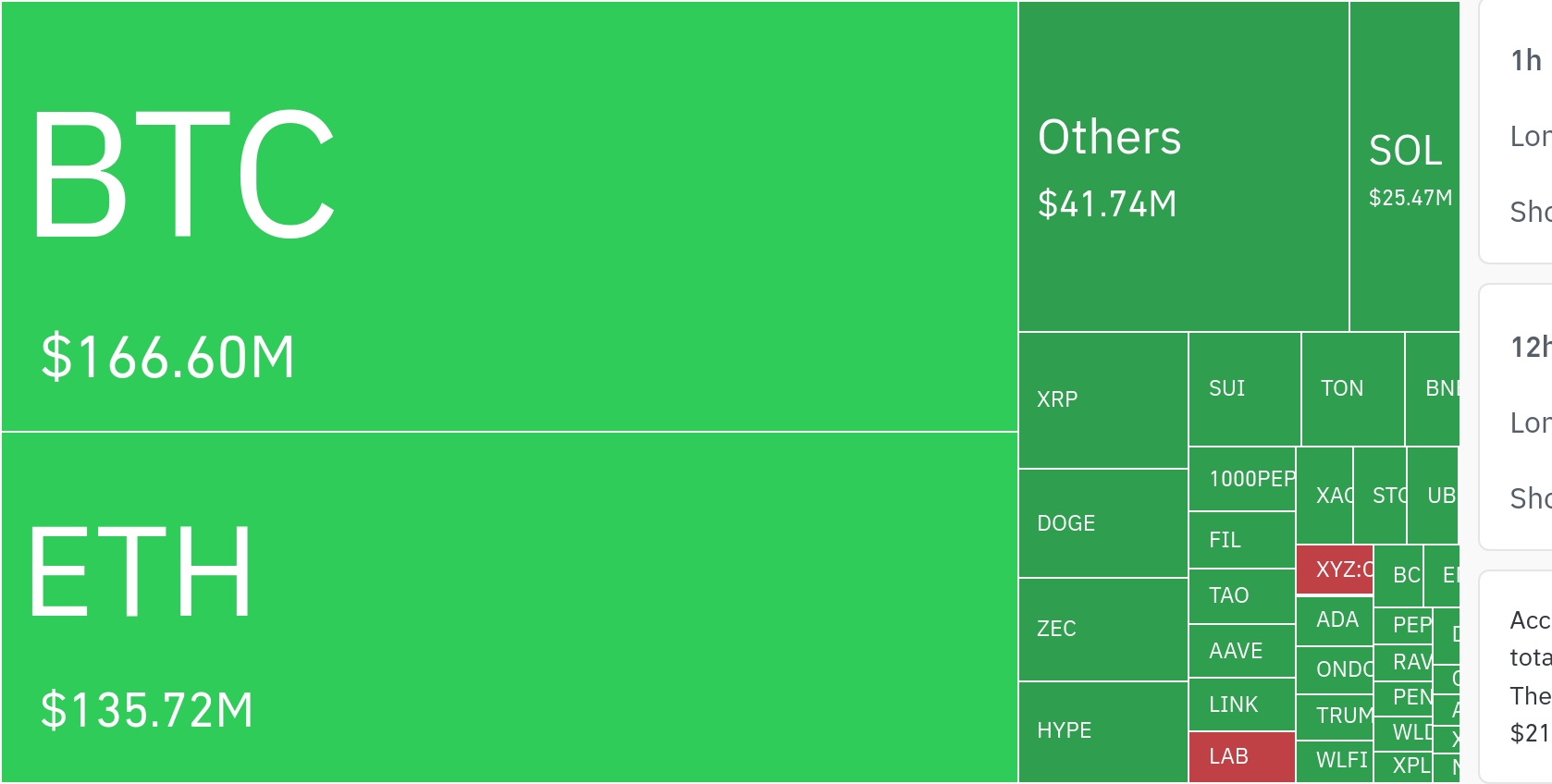
By asset, Bitcoin (BTC) saw the largest forced unwind, with about $166.60 million liquidated over 24 hours. Ethereum (ETH) followed at roughly $135.72 million, underscoring that the bulk of the deleveraging was concentrated in the two largest markets where perpetual futures activity is deepest. Solana (SOL) recorded about $25.47 million in liquidations.
Liquidations also spread across major altcoins. XRP (XRP) accounted for around $18.8 million over the past day, while Dogecoin (DOGE) saw roughly $1.5 million. The AXL token drew attention after falling about 7.8%, a reminder that thinner-liquidity altcoins can experience outsized swings that quickly trigger forced closures.
Market observers often treat liquidation clusters as a real-time gauge of stress in leveraged positioning. The dominance of long liquidations points to a market that had leaned bullish into the move and then faced an abrupt volatility spike, while pockets of short liquidations on large exchanges suggest intermittent countertrend rallies that punished late sellers.