
TokenPost.ai
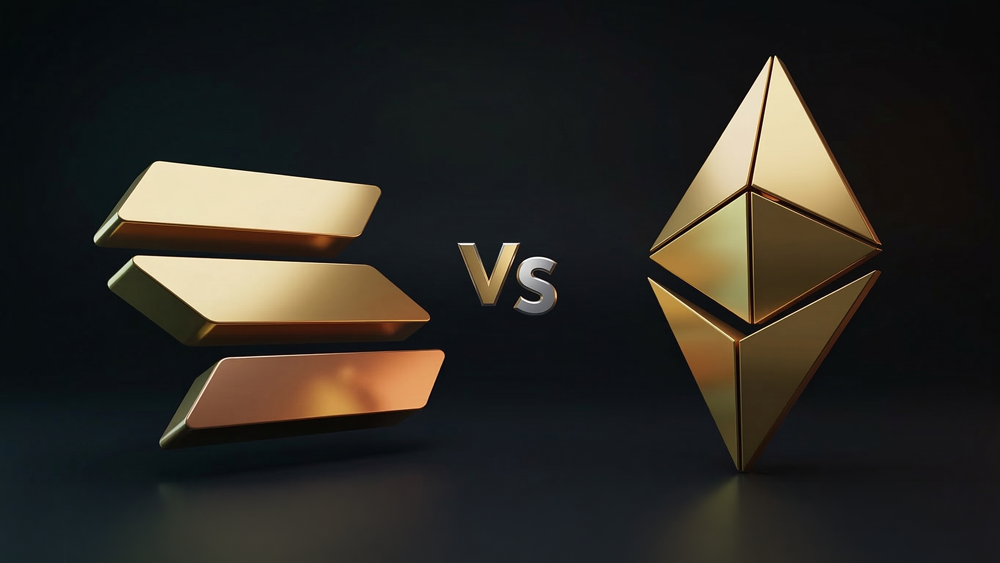
Ethereum (ETH) is under renewed scrutiny after a sharp drop in daily fee revenue, even as longer-term figures suggest the network is still monetizing more economic activity than its closest high-throughput rival, Solana (SOL). The divergence is highlighting a deeper debate across crypto markets: whether Ethereum’s 'high-value settlement' model can keep outperforming a 'high-volume execution' chain as activity migrates to layer-2 networks.
As of March 29 (UTC), Ethereum posted about $7.38 million in 24-hour fees, down 13.77% from the prior day. Solana recorded roughly $6.14 million, off 4.28% over the same period. While the one-day comparison makes Solana look steadier, the broader picture remains more favorable to Ethereum: seven-day cumulative fees stood at about $61.78 million for Ethereum versus $35.59 million for Solana, and 30-day cumulative fees were about $322.12 million for Ethereum compared with $191.10 million for Solana.
Market observers say the key issue is not simply demand weakening on Ethereum, but demand relocating. Major Ethereum L2s such as Base are increasingly capturing transaction flow and fee revenue that would previously have been recorded on the mainnet. In practice, similar economic activity is still occurring in the Ethereum ecosystem, but the 'fee surface area' is shifting outward—reducing apparent L1 revenue even as usage remains resilient at the stack level.
Solana, by contrast, continues to concentrate activity on its base layer. High-frequency use cases—memecoin trading, decentralized exchange (DEX) volume, and NFT-related transactions—tend to remain on L1, translating directly into fees and contributing to comparatively lower day-to-day volatility. Supporters of the Solana model frame this as a self-reinforcing loop: 'high speed and low cost' encourages 'mass transaction throughput,' which in turn sustains a more stable stream of fee generation.
Despite the near-term gap narrowing, Ethereum’s advantage over 30 days—roughly 1.7x Solana’s total—suggests that higher-value financial activity remains anchored to Ethereum’s broader architecture. Analysts point to DeFi, stablecoin settlement, and real-world asset (RWA) tokenization as the types of activity that may be less sensitive to per-transaction costs and more reliant on liquidity depth, composability, and institutional-grade infrastructure.
One catalyst increasingly discussed in this context is Circle (CRCL) and its reported strategic push to build a payments-focused infrastructure where USDC functions as a gas token on its own L1, described as 'Arc.' If realized at scale, such an initiative would represent more than another chain launch—it would signal an attempt to standardize an 'onchain dollar payments network' where recurring settlement activity drives predictable fees.