
TokenPost.ai
Ethereum (ETH) options markets showed a renewed tilt toward bullish positioning on Wednesday, with open interest climbing and call options taking a clear majority share—signaling that traders are increasingly paying for upside exposure even as short-dated flows concentrate around higher strike levels.
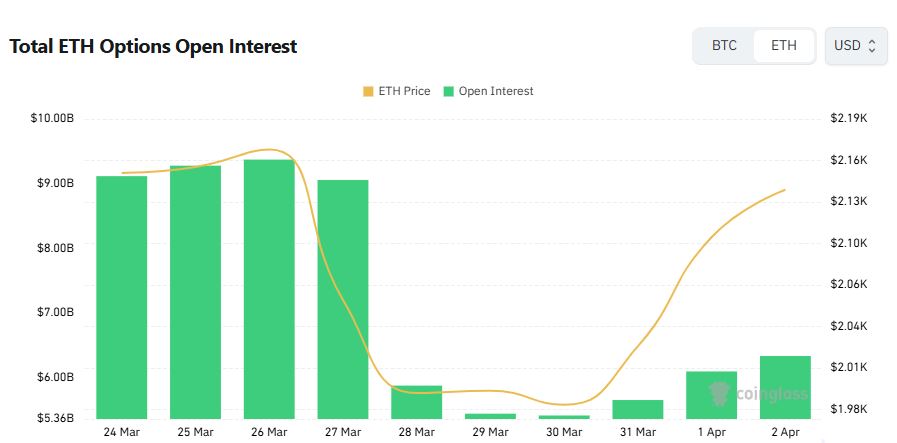
As of 00:00 UTC on April 2, aggregated data from Coinglass put total Ethereum options open interest (OI) at $6.34 billion, up about 3.9% from $6.10 billion a day earlier. Calls accounted for 63.28% of outstanding contracts, compared with 36.72% for puts—an allocation that points to stronger demand for 'upside bets' across the broader options complex.
Trading activity over the past 24 hours also leaned toward calls, though less decisively. Coinglass data showed call options representing 59.09% of volume, versus 40.91% for puts—suggesting that while traders are adding bullish exposure, a meaningful share of flows remains dedicated to downside hedging and volatility positioning.
By open interest, several large call strikes stood out as key magnets for positioning. The biggest concentrations were in the $3,200 call expiring Dec. 25 on Deribit, followed by the $2,500 call and the $2,000 call—both expiring June 26 on Deribit. The clustering around those levels suggests longer-dated participants are building exposure around widely watched psychological and technical zones, with a notable emphasis on strikes that would benefit from a sustained ETH recovery.
Shorter-dated activity, however, painted a more tactical picture. In the past 24 hours, the most actively traded contracts were the $3,500 call expiring April 3 on Bybit, the $3,000 call expiring April 3 on Bybit, and a $500 put expiring April 10 on Bybit. Heavy turnover in near-expiry calls often reflects traders positioning for a quick upside move or using options to express directional views with defined risk, while activity in deep-out-of-the-money puts can be consistent with 'tail-risk' hedging strategies.
Options are derivatives that allow investors to take leveraged views on an underlying asset’s price or hedge existing holdings. A 'call option' grants the right—without the obligation—to buy the asset at a predetermined price by a set date, typically used to express a bullish outlook. A 'put option' similarly provides the right to sell at a set price, often used to position for declines or to protect spot exposure.