
TokenPost.ai
Korbit Research Center, the research arm of South Korean crypto exchange Korbit, says the market for 'perpetual futures' is rapidly expanding beyond cryptoassets into 'real-world assets' (RWA)—a shift that is beginning to blur the line between offshore derivatives trading and traditional capital markets.
In a report released Thursday ET, titled Perpetual Futures: Beyond Crypto Markets to RWA, the center outlined how both centralized and decentralized venues have accelerated the listing and adoption of perpetual contracts tied to stock indices, individual equities, and even FX rates. Perpetual futures are derivative contracts designed to track an underlying asset price without an expiry date, typically relying on a 'funding rate' mechanism to keep prices anchored to spot markets.
According to the report, global centralized exchanges such as Binance have used offshore licensing structures and proprietary indices to list new perpetual products quickly, while decentralized perpetual exchanges—often referred to as 'perp DEXs'—have pushed listing authority into protocol-level governance. Korbit pointed to Hyperliquid as a leading example of this trend, arguing that the shift has materially increased the speed at which new RWA-linked contracts can be launched and traded.
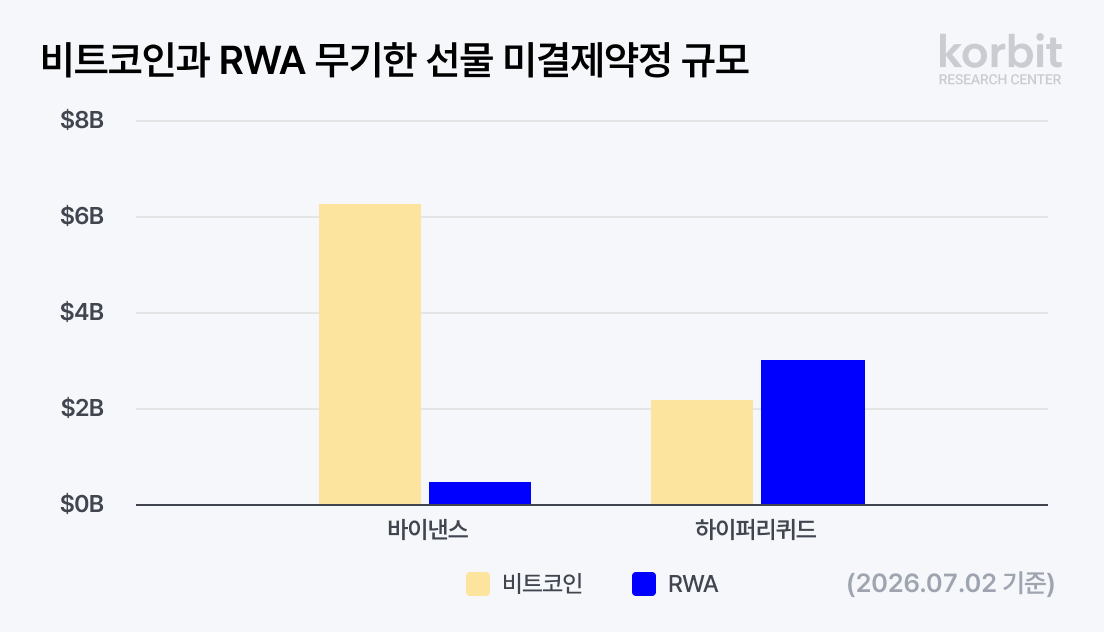
Korbit’s data highlights the scale of the move: as of July 2, open interest in Hyperliquid’s RWA perpetual futures reached roughly $2.9 billion, exceeding open interest in the venue’s Bitcoin (BTC) perpetual futures at about $2.1 billion. Open interest is a widely watched measure of derivatives positioning, reflecting the notional value of outstanding contracts and offering a proxy for market participation and leverage.
The report also tested how reliably these RWA perpetual products track their reference markets. Using publicly available data and its own verification methods, Korbit found that an S&P 500 perpetual closely replicated index and futures pricing during U.S. market hours with a correlation coefficient of 0.98—suggesting minimal distortion under normal trading conditions. In another case, a perpetual linked to SK hynix showed a high correlation of 0.97 to 0.99, and appeared to 'pre-price' the next day’s opening level during overnight hours when South Korea’s cash equity market was closed.
However, Korbit cautioned that price formation becomes more fragile when there is no credible spot reference. Perpetual contracts tied to private companies such as Cerebras and SpaceX, the report said, effectively generate their own prices within the exchange ecosystem due to the absence of observable spot-market transactions. That dynamic raises questions about how markets should interpret these instruments—particularly during volatility, low liquidity, or liquidation cascades.