
TokenPost.ai
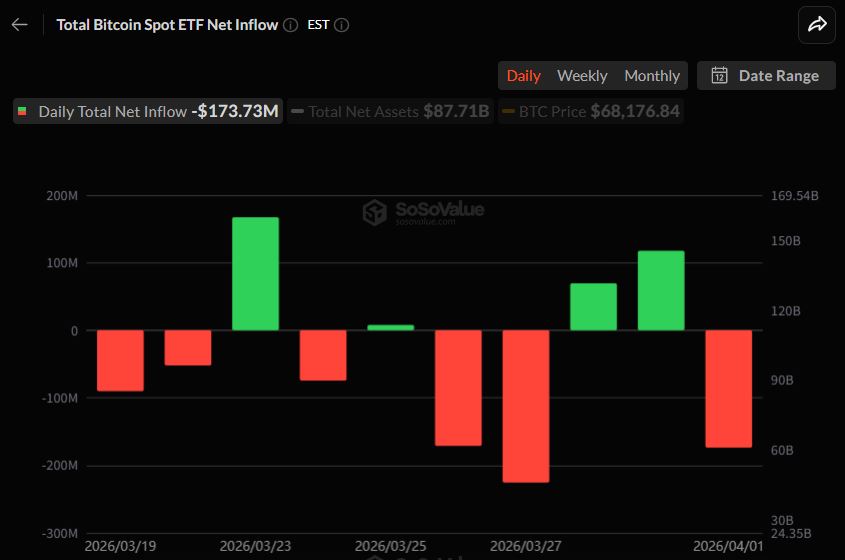
US spot Bitcoin (BTC) exchange-traded funds (ETFs) swung back to net outflows on Tuesday ET, signaling a short-term cooling in demand after two consecutive sessions of inflows and adding to a risk-on/risk-off tone across digital asset markets.
According to data compiled by Sosovalue, the 12 spot Bitcoin ETFs recorded a combined daily net outflow of $173.73 million on April 1 ET. The reversal comes after a brief two-day streak of net inflows, highlighting how sensitive ETF demand remains to shifts in macro expectations, crypto volatility, and tactical positioning by large allocators.
Outflows were concentrated in the largest and most liquid products. BlackRock’s iShares Bitcoin Trust (IBIT) posted $86.52 million in net redemptions, while Fidelity’s Wise Origin Bitcoin Fund (FBTC) saw $78.64 million exit. Grayscale Bitcoin Trust (GBTC) recorded $13.26 million in outflows, and Bitwise Bitcoin ETF (BITB) lost $5.55 million. Grayscale’s Mini Bitcoin Trust was the only fund to register net inflows, adding $10.25 million, while the remaining ETFs were flat on the day.
Despite the net redemption print, trading activity remained elevated. Total spot Bitcoin ETF turnover reached $2.11 billion on the session, led by IBIT with $1.33 billion in volume, followed by FBTC at $321.6 million and GBTC at $136.07 million. Market participants often view heavy volume during outflow days as a sign of active rebalancing—potentially reflecting hedging, rotation between products, or short-term de-risking rather than a broad withdrawal of long-term capital.
Cumulatively, spot Bitcoin ETFs have attracted $55.95 billion in net inflows since launch, Sosovalue data showed, underscoring that the longer-term trend remains positive even as day-to-day flows fluctuate. Total net assets across the category stood at $87.71 billion, equivalent to roughly 6.43% of Bitcoin’s total market capitalization.
By assets under management, IBIT remained the clear leader at $53.31 billion, followed by FBTC at $12.74 billion and GBTC at $10.53 billion. The concentration in the top products continues to shape flow dynamics, as reallocations among the largest funds can meaningfully move the headline daily numbers.
The return to net outflows is likely to keep investor attention on whether ETF demand can stabilize amid shifting market narratives. For now, the data suggests a market that is still drawing substantial cumulative capital, but one where near-term 'liquidity' and 'risk appetite' can change quickly.